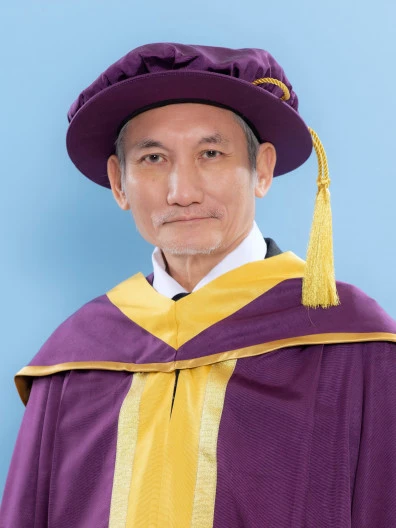
TSUI Hark
2026 Honorary Doctorate
Citation
Mr Tsui Hark is one of the most influential and visionary figures in contemporary Hong Kong cinema, instrumental in bringing it to the world stage. As a director, producer, screenwriter and creative innovator, he has played a transformative role in shaping the artistic identity and international reputation of Hong Kong’s film industry. A pioneering force behind the Hong Kong New Wave film movement and a principal architect of the city's cinematic golden era, his work has redefined the possibilities of action filmmaking and inspired generations of filmmakers around the world.
During the late 1960s, Mr Tsui moved to the United States to study film, graduating from the University of Texas at Austin. After returning to Hong Kong in 1977, he began his career in television before making his feature-film debut directing The Butterfly Murders (1979), a bold and visually innovative work that established him as a leading voice of the Hong Kong New Wave. This was followed by Dangerous Encounters of the First Kind (1980), a special and uncompromising film that further cemented his reputation as a daring and unconventional storyteller.
In the 1980s, Mr Tsui emerged as both a creative trailblazer and a commercial innovator. His landmark fantasy epic Zu: Warriors from the Magic Mountain (1983) introduced groundbreaking visual effects and helped usher Hong Kong cinema into a new technological era. Together with prestigious film producer Nansun Shi, they founded the Film Workshop Limited in 1984, a production company that became synonymous with artistic excellence and massive commercial success. Under their leadership, Film Workshop produced timeless classics that helped define Hong Kong cinema, including John Woo's A Better Tomorrow (1986) and Ching Siu-tung's A Chinese Ghost Story (1987), films that revitalised their respective genres and achieved enduring international acclaim. Meanwhile, Mr Tsui helmed Shanghai Blues (1984), Peking Opera Blues (1986) and Once Upon a Time in China (1991).
Renowned for his boundless imagination and kinetic visual language, Mr Tsui possesses a rare ability to reinvent cinematic tradition. His celebrated Once Upon a Time in China series elevated the legendary folk hero Wong Fei-hung into a symbol of cultural identity who still grips the national consciousness. Works such as Green Snake (1993), The Blade (1995), and Time and Tide (2000) further demonstrated Mr Tsui’s remarkable artistic versatility and willingness to challenge conventions of genre, narrative and form.
Always moving with the times, Mr Tsui continued to push the boundaries of cinematic technology and storytelling. His movie Seven Swords was invited to be the opening film at the 62nd Venice International Film Festival in 2005. His visionary use of digital effects and stereoscopic filmmaking helped pioneer 3D cinema in the Chinese-speaking world, most notably through Flying Swords of Dragon Gate (2011) and The Taking of Tiger Mountain (2014). Across a career spanning more than four decades, he has consistently expanded the language of cinema while nurturing talent and shaping the development of the film industry through Hong Kong, the Chinese Mainland and beyond.
Mr Tsui’s contributions to The Hong Kong Academy for Performing Arts extend far beyond his Honorary Fellowship in 2007, and are defined by sustained, hands-on engagement with the next generation of filmmakers. Through his generous initiative to host exclusive film screenings for students from the School of Film and Television, he has offered rare access to major works such as The Taking of Tiger Mountain, The Battle at Lake Changjin, and Septet: The Story of Hong Kong. These sessions do more than showcase masterful storytelling. They also serve as living classrooms, bridging the gap between theoretical study and professional practice. By sharing his creative process and cinematic vision first-hand, Mr Tsui has helped deepen students’ learning, inspired their artistic growth, and reaffirmed his personal dedication to nurturing Hong Kong’s future filmmaking talent. His goodwill and legacy of mentorship will continue to enrich the Academy community.
Through his extraordinary film works, unwavering commitment to innovation, and profound influence on generations of filmmakers and audiences, Mr Tsui has secured his place among the legendary and most distinguished figures in world cinema. His artistic excellence and contributions continue to inspire and elevate the arts and cultural landscape of Hong Kong as well as the international film industry.