Making the Arts Accessible
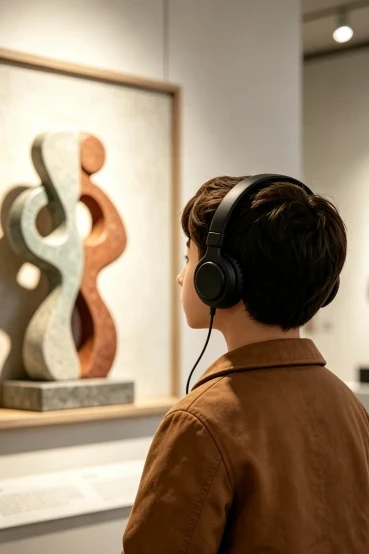
The Academy is committed to advancing inclusive arts practices and empowering students to engage with diverse communities. As part of this effort, Audio Description (AD)—a form of narration that conveys key visual elements to enhance accessibility for visually impaired audiences—has been introduced as a practical tool for inclusive communication in the performing arts.
To equip students with foundational knowledge and hands-on experience in arts accessibility, the Academy’s Student Recruitment and Community Engagement Office organised an “Introduction to Audio Description Workshop” on 30 May 2026 for the first time. Delivered in collaboration with guest speakers from the Arts with the Disabled Association Hong Kong, the three-hour session covered essential concepts of inclusive practice and provided practical training in applying AD techniques.
Through the workshop, students explored how AD serves not only as a technical skill, but also as a meaningful approach to expanding audience engagement and participation. Following the session, an AD option was provided to three selected artworks showcased at the 2026 TEA Graduation Exhibition, enhancing arts accessibility.
Accessible arts allows everyone regardless of their abilities and background to engage in the appreciateion and enjoyment of arts. The Academy looks forward to seeing students continue to develop their interest and capabilities in inclusive performing arts, contributing to a more accessible and connected cultural landscape.
Arts Accessibility Service
2026 TEA Graduation Exhibition
(Translation of the Cantonese script)
Winky Wing-yin Ngai, prop artwork, "Beast?"
Composite media include hand-painted 3D printing, artificial fur, a microprocessor, and a motor.
Length 65 cm, Width 35 cm wide, Height 70 cm
The artwork is a giant, ferocious wolf head, entirely covered in thick gray fur. Its ears are erect, with creamy-white inner lining. The wolf has bright amber eyes with dilated black pupils, deep-set sockets, and a sharp gaze. The long snout leads to a large, black nose with a glossy tip. The mouth is slightly open, revealing two rows of sharp, ivory-colored teeth, some of which are exceptionally long and pointed, three times the length of the other teeth. The lips have a reflective sheen, creating a moist, drooling effect. The neck fur is relatively long, fading from dark gray to grayish-white.
Creative Concept: This wolf head is a dynamic costume prop, designed to break through the limitations of traditional static mascots. Through a mechanical system connected to programming software, the wolf head can blink randomly, and performers can also control the wolf head's jaw and ears to move and make lifelike expressions from inside the prop head.
(Translation of the Cantonese script)
Nikkie Ho-tung Leung, "Howl's Moving Castle", prop artwork.
Media: Wood, cardboard, EVA foam, thermoplastic, motor
Height 75 cm, Width 40 cm, Length 90 cm.
This artwork is a moving castle that can move slowly in a straight line. The overall color is brownish-red with a rough wooden texture, accented with silver accessories. The upper part consists of four cylindrical towers of varying heights, connected closely at the 12 o'clock, 3 o'clock, 6 o'clock, and 9 o'clock positions. The top is a hemisphere surrounded by a silver, toothed wall, resembling a crown. The clock tower at 3 o'clock has five staggered tubular chimneys that emit white smoke when the castle moves. Beside the chimneys are stacked Western-style wooden houses with beige walls and numerous windows, their yellow and orange sloping roofs covered with delicate tiles. Each of the other towers has a pair of circular cannon barrels on its top. The towers at 12 o'clock and 6 o'clock sway from side to side as the castle moves.
The lower half of the castle consists of a group of oval, lifelike machines. At 9 o'clock is the head of one of these machines, with shell-like textures and a pair of retractable tubular eyes about five centimeters long. At 6 o'clock and 12 o'clock are a pair of legs resembling bones with pine cones inserted; these legs drag on the ground as the castle moves. At 1 o'clock and 5 o'clock are ear-shaped reliefs, and at 2 o'clock and 4 o'clock are fin-like wings. Scattered throughout the castle are small houses with red and yellow roofs.
The castle sits on green grass, with a backdrop of white clouds, grey-white snow-capped mountains, and a gradually changing blue sky.
Creative Concept: The work aims to bring movie scenes into reality and give machines personality. Through the combination of motors, code, and cardboard, it presents the audience with a dynamic performance.
(Translation of the Cantonese script)
Lok Yi, "Barbie", scenic artwork.
Mterials: plywood and water-based paint
Width 4.5m wide and Height 2.4m
The entire work blends sweet to vibrant pink tones. The main subject is a rectangular wall with a pair of peach-pink doors in the center, occupying about 1/4 of the wall's width. The doors are covered with delicate mirrored "B" patterns, and the gold mirrored "B" doorknobs are tied with lace bows. Above the doors is an arched Barbie sign, bordered by dazzling neon lights.
When the doors open, viewers can see Barbie's treasured collection of glasses, handbags, and gloves.
On either side of the doors are tropical garden scenes. The lower half of the painting features lush green shrubs and a pink wall. Above the wall, dense banana leaves and palm trunks peek out, obscuring the blue sky and white clouds in the background.
In the foreground, on the left, is a pink chair and a small round table, on which sits a pink telephone, a handbag, and a comb. On the right, a pair of pink woven rattan screens with classically carved tops. The floor in the foreground is covered with irregular pink slate patterns.
Lok Yi uses the technique of "optical illusion," employing light and shadow and perspective to create a three-dimensional, romantic Barbie world on a two-dimensional plane.